
COLLEGE RECRUITING CALENDARS BY SPORT
When and how NCAA college coaches can watch and have contact with athletes varies by sport and division. Below are key recruiting calendar terms to know when looking at each recruiting calendar. Knowing these dates can help you determine what is allowed by college coaches when recruiting athletes. Keep these dates in mind when going through the recruiting process. Recruiting calendars are yearly guides college coaches must follow. To see when and how college coaches can first start contacting athletes, go to our WHEN COLLEGES CAN CONTACT ATHLETES page.
Click below to view each recruiting calendar:
NCAA DIVISION I
NCAA Division I Baseball Recruiting Calendar
NCAA Division I Men’s Basketball Recruiting Calendar
NCAA Division I Women’s Basketball Recruiting Calendar
NCAA Division I Cross Country and Track and Field Recruiting Calendar
NCAA Division I Football FBS Recruiting Calendar
NCAA Division I Football FCS Recruiting Calendar
NCAA Division I Men’s Golf Recruiting Calendar
NCAA Division I Men’s Lacrosse Recruiting Calendar
NCAA Division I Women’s Lacrosse Recruiting Calendar
NCAA Division I Softball Recruiting Calendar
NCAA Division I Women’s Volleyball Recruiting Calendar
NCAA Division I Beach Volleyball Recruiting Calendar
NCAA Division I Other Sports Recruiting Calendar
NCAA DIVISION II
The recruiting calendar for NCAA Division II is much more simple than NCAA Division I with much fewer restrictions. DII generally does not use the same elaborate recruiting-period structure for most sports.
- Coaches often have broader freedom to communicate and evaluate
- There are fewer dead periods
- Rules are easier to navigate
That flexibility can make DII recruiting feel more personal and less rigid. DII coaches can evaluate athletes at any time, except the following times:
Football
- 7 a.m. Nov. 30, 2026 to 7 a.m. Dec. 2, 2026: DEAD PERIOD for 2-year college prospective athletes who intend to enroll mid-year.
- 7 a.m. Feb. 1, 2026 to 7 a.m. Feb. 3, 2026: Signing dates DEAD PERIOD.
All Other Sports
- 7 a.m. Nov. 9, 2026 to 7 a.m. Nov. 11, 2026: Signing dates DEAD PERIOD.
NCAA Division II Recruiting Calendar
NCAA DIVISION III
NCAA Division III recruiting is generally the least restrictive and most flexible of the three NCAA divisions. Compared with NCAA Division I and NCAA Division II, Division III places much less emphasis on tightly controlled recruiting calendars and more emphasis on academics, institutional fit and direct coach-athlete communication.
Evaluation Periods
Unlike Division I and II, Division III does not have specific evaluation periods that restrict when coaches can assess athletes. Coaches can evaluate athletes during competitions and events without the same limitations.
NAIA AND JUCOS
NAIA and JUCOs do not have recruiting calendars. For more info on NAIA and JUCOs go to our NAIA AND JUCO GUIDELINES page.
Myth: “I don’t have to worry about recruiting until I’m a junior or senior”
What is a college coach’s primary focus when recruiting a game or tourney?
RECRUITING CALENDAR PERIODS
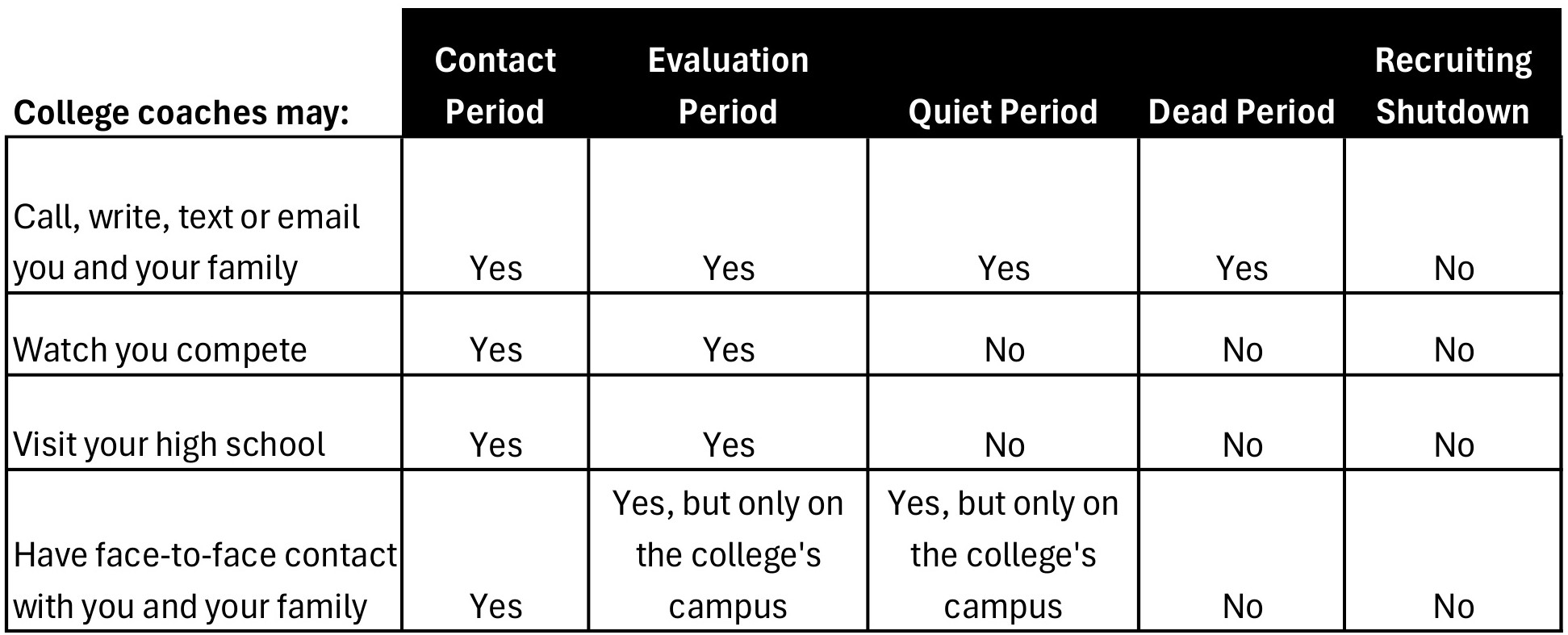
Here’s a quick breakdown of what is allowed for each recruiting period:
contact period
What is it?
A college coach may have face-to-face contact with college-bound student-athletes or their parents, watch student-athletes compete or visit their high schools and write or telephone student-athletes or their parents. College coaches cannot have contact you in person on competition or practice days until you are finished for the day and are dismissed by the proper authority.
Expert Advice
This period is commonly used by coaches to meet with athletes at their school, home, tournaments or showcase events. During this time, coaches focus on building relationships with their top recruits while finalizing scholarship offers and roster decisions. Meeting recruits and their families in person allows coaches to better understand an athlete’s character, personality and overall fit within the team culture and campus community.
These in-person meetings also provide recruits with an important opportunity to connect with coaches outside of the college setting. It’s a valuable time for athletes and families to ask detailed questions about the program, team environment, academics and campus life. If you have any concerns or uncertainties about a school, use these conversations to gather information and determine whether the program is the right fit for you academically, athletically and personally.
EVALUATION period
What is it?
A college coach may watch college-bound student-athletes compete, visit their high schools and write or telephone student-athletes or their parents. However, a college coach may not have face-to-face contact with college-bound student-athletes or their parents off the college’s campus during an evaluation period.
Expert Advice
QUIET PERIOD
What is it?
A college coach may only have face-to-face contact with college-bound student-athletes or their parents on the college’s campus. A coach may not watch student-athletes compete (unless a competition occurs on the college’s campus) or visit their high schools. Coaches may write or telephone college-bound student-athletes or their parents during this time.
Expert Advice
Even though coaches are not allowed to conduct off-campus recruiting visits during the quiet period, recruiting activities continue. Many prospects take advantage of this time by scheduling unofficial visits. Since coaches cannot travel to meet athletes in person, recruits often choose to visit campuses instead. Unofficial visits give student-athletes the opportunity to tour the campus, meet with the coaching staff, view athletic facilities and get a feel for the overall campus environment and culture. Because coaches are still permitted to communicate through calls, texts and emails during this period, arranging a visit is typically straightforward.
dead PERIOD
What is it?
A college coach may not have face-to-face contact with college-bound student-athletes or their parents and may not watch student-athletes compete or visit their high schools. Coaches may write and telephone student-athletes or their parents during a dead period.
Expert Advice
The term “Dead Period” seems like nothing can be done by college coaches with athletes during this time. However, college coaches can still call, text, have online/Zoom chats and have email communication with athletes during this time.
RECRUITING SHUTDOWN
What is it?
A recruiting shutdown is a period of time when no form of recruiting (e.g., contacts, evaluations, official or unofficial visits, correspondence or making or receiving telephone calls) is permissible.
Expert Advice