
NCAA RECRUITING GUIDELINE
OVERVIEW
The National Collegiate Athletic Association (NCAA) is the largest governing body for college sports. There are 1,100 members in the NCAA (as of April 2026) across its three divisions (366 at D1, 305 at D2 and 429 at D3). Typically the largest schools in the country are Division I, however, there are small D1 schools and larger D2 and D3 schools.
In Division I and II there are schools spread out all over the country. In Division III, however, most of the schools are located in the Midwest and Northeast.
Division I
Division I programs are located nationwide and are typically larger — median undergraduate enrollment is about 8,960 students. There more than 190,000 student‑athletes competing at this level. Recruiting is highly competitive because of the elevated playing standard and the limited number of programs and roster spots.
Division II
Division II competition remains competitive, but athletes typically spend less time on training and competition than Division I players. During the competitive season, D2 student‑athletes are entitled to one day off per week from athletic activities.
Division III
If you want a more balanced college experience, NCAA Division III could be a great fit. D3 athletes stay committed to their sport but have more time for a broader college life — clubs, study abroad or even playing multiple sports are more attainable at this level.
Sports offered
The NCAA conducts 90 national championships in 24 sports:
- Basketball (Men’s and Women’s)
- Baseball (Men’s)
- Beach Volleyball (Women’s)
- Bowling (Women’s)
- Cross Country (Men’s and Women’s)
- Fencing (Men’s and Women’s)
- Football (Men’s)
- Field Hockey (Women’s)
- Golf (Men’s and Women’s)
- Gymnastics (Men’s and Women’s)
- Ice Hockey (Men’s and Women’s)
- Lacrosse (Men’s and Women’s)
- Rifle (Men’s and Women’s)
- Skiing (Men’s and Women’s)
- Rowing (Women’s)
- Soccer (Men’s and Women’s)
- Swimming and Diving (Men’s and Women’s)
- Tennis (Men’s and Women’s)
- Softball (Women’s)
- Indoor Track and Field (Men’s and Women’s)
- Outdoor Track and Field (Men’s and Women’s)
- Volleyball (Men’s and Women’s)
- Water Polo (Men’s and Women’s)
- Wrestling (Men’s)
NCAA DIVISION I SIGNING PERIODS
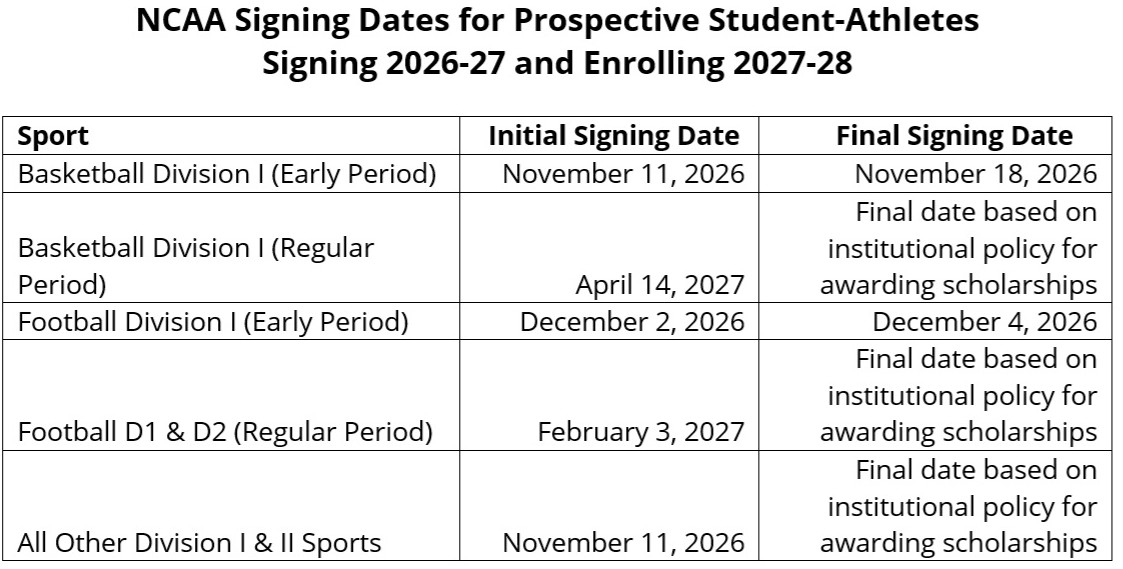
The NCAA eliminated the National Letter of Intent program in October 2024. The signing dates still remain. Now athletes sign an agreement with the specific school they are committing to and the signing terms are not linked to the NCAA. Division III institutions are permitted to use a standard, NCAA provided, non-binding celebratory signing form. A college-bound student-athlete is permitted to sign the celebratory signing form at any point, including high school signing events, after the student-athlete has been accepted to the institution. Below are the signing periods by sport:
NCAA ELIGIBILITY CENTER
What is it?
The NCAA Eligibility Center is the NCAA’s clearinghouse that determines whether high school athletes are academically and amateurism-eligible to compete in NCAA Division I and II sports.
What it does
The Eligibility Center reviews:
- Academic eligibility: Confirms you completed the required core courses and meet GPA/test score standards for Division I or II.
- Amateurism status: Verifies you have not violated NCAA amateurism rules (professional contracts, improper benefits, etc.).
- Recruiting and enrollment certification: Schools use the certification before you can practice, compete, or receive athletics aid.
Who needs to register
You should register if you want to compete at the D1 or D2 levels. D3 schools do not require registration with the eligibility center. However, can still create a Profile Page Account (more on that below).
Types of accounts
Academic and Athletics Certification Account: Athletes looking to play D1 or D2. It’s required you’re registered with this account before you can do D1 official visits. There is a cost for this option. See the NCAA Eligibility Center website for the current cost.
Athletics Certification Account: International athletes enrolling at a D3 school. There is a cost for this option. See the NCAA Eligibility Center website for the current cost.
Profile Page Account (free): Athletes only considering D3 schools or if you’re not yet in high school or secondary school. This option is free.
NCAA 5 in 5 rule
What is it?
The NCAA’s new “5-in-5” rule is a major change to Division I eligibility, and it is especially important for recruiting because it changes how coaches and athletes think about redshirting, junior college, transfers, and taking time off. The rule was officially adopted by Division I on June 23, 2026 and by Division II on Aug. 5, 2026. Division III has not yet adopted this rule. Athletes now have 5 years to potentially compete in 5 seasons during a 5-year eligibility window. Previously, athletes could compete in 4 seasons and redshirts and injuries could get the athlete another year to play. The NCAA says the new model eliminates season-of-competition limits, sport-specific eligibility rules, traditional redshirt rules and most eligibility-extension waivers.
When does the 5-year clock start?
The new system is age-based. For a typical student who graduates high school around age 18 and immediately goes to college, the practical result is generally:
High school graduation → college → 5 consecutive years of eligibility.
An athlete’s 5-year eligibility clock begins at whichever occurs first:
- The athlete’s initial full-time enrollment at a college or university, or
- The academic year immediately following the athlete’s 19th birthday.
How this affects high school recruits
Now that college athletes can play 5 years, colleges that have players coming back for a 5th year means they are recruiting less players out of high school, making college recruiting even more competitive than ever for high school athletes, because there are less roster spots available.
How this affects college freshman
Previously, if a college coach felt a freshman wasn’t quite ready to compete, that player would be redshirted, so the athlete would keep all 4 years of his/her eligibility. Now, that freshman could at least get some playing time and it doesn’t affect his/her number of remaining eligible years.
NCAA DIVISION I SCHOLARSHIPS
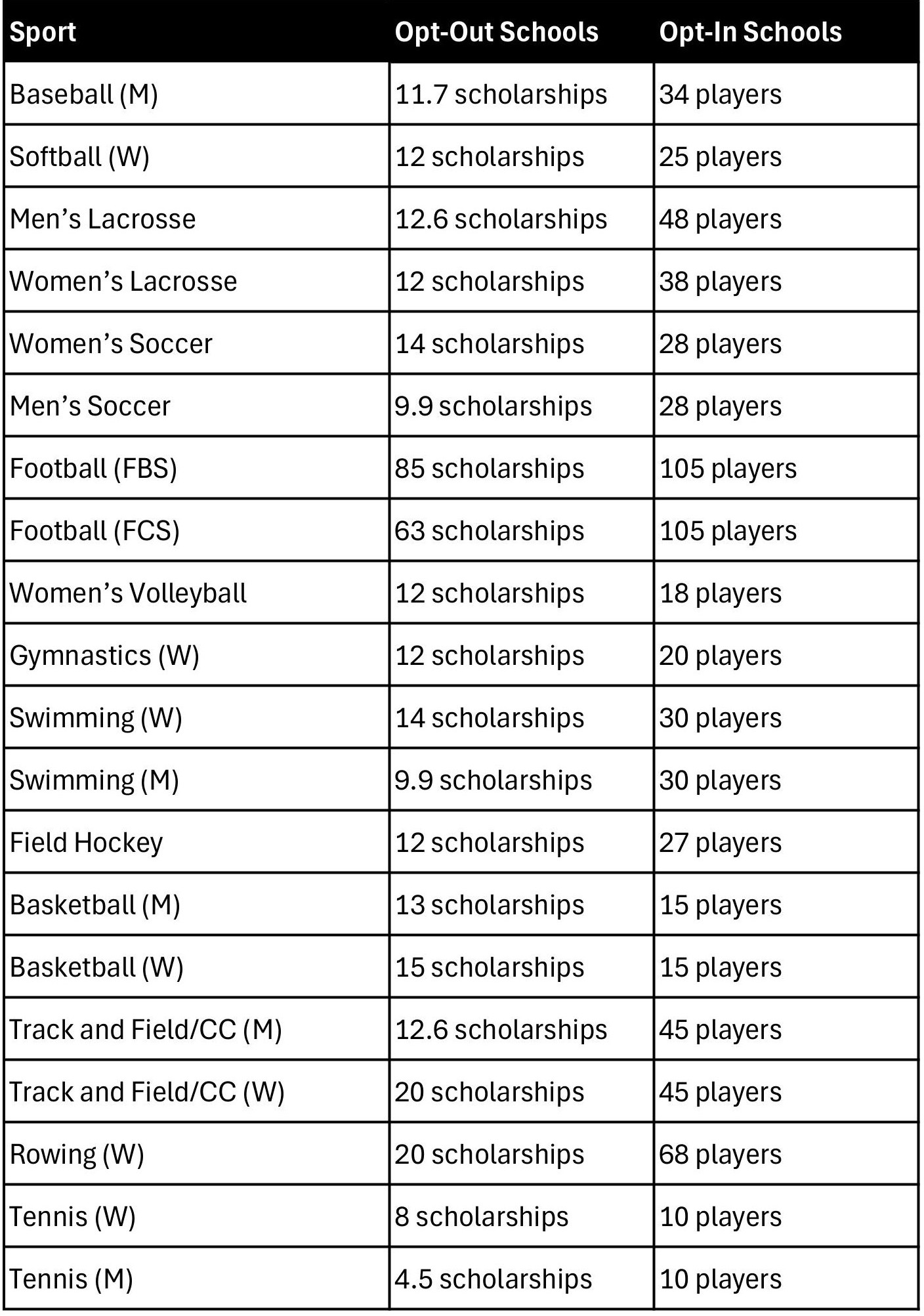
A full-ride scholarship generally covers tuition, fees, room and board, and course-related costs (like books). Receiving a full-ride in year one does not guarantee it for subsequent years — coaches renew scholarships annually. However, multiple-year scholarship offers are permitted. Full rides are offered at the NCAA Division I level. Under the new NCAA settlement model, schools that opt in may offer unlimited scholarships but must adhere to strict roster caps; previously the limit was on the number of scholarships, now it’s on roster size. Programs can offer full or partial scholarships.
Below is a breakdown of the new roster caps for key Division I sports. Note that some programs will opt in and others will not (see those schools below).
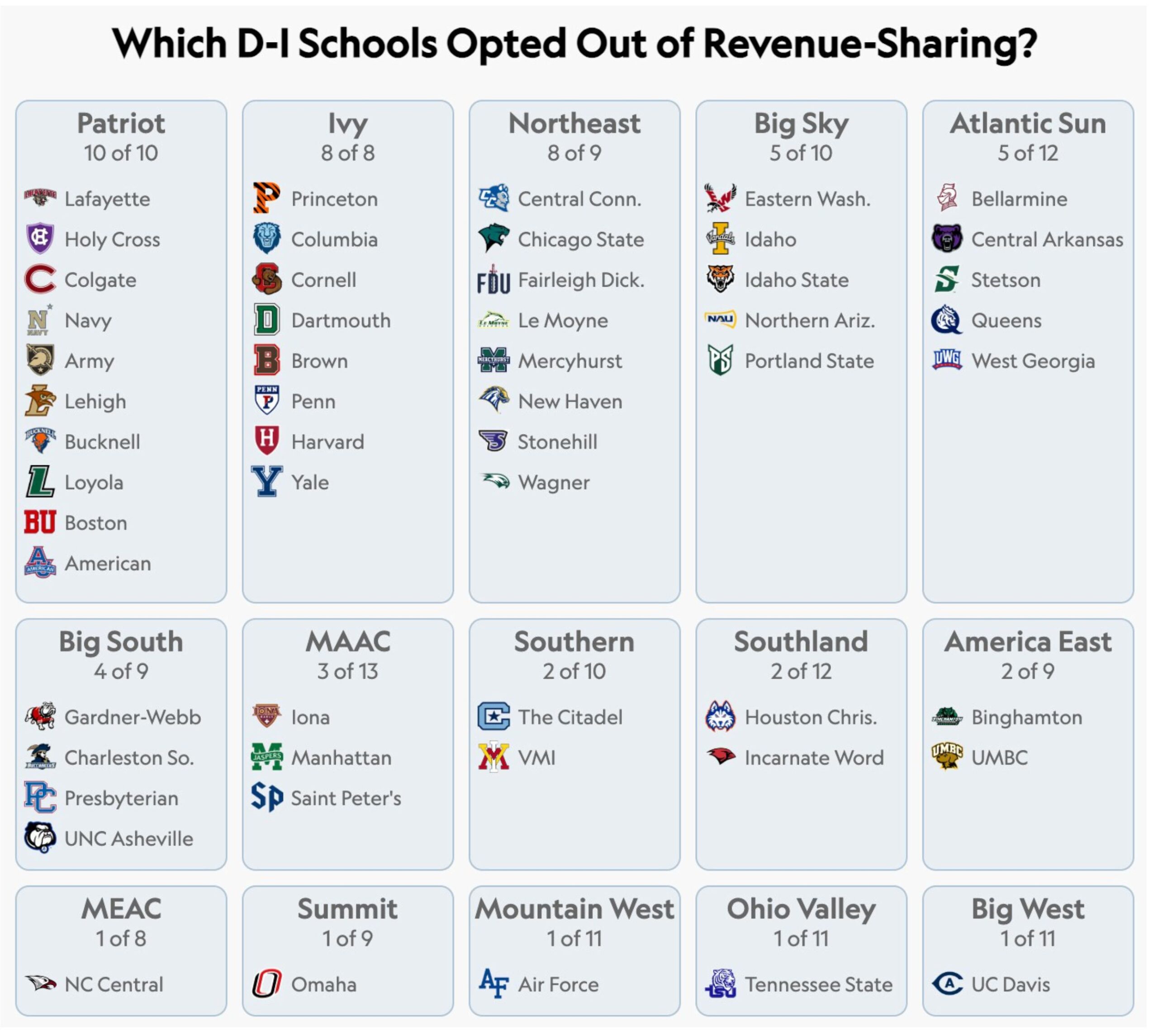
Programs that haven’t opted into the settlement will keep the old scholarship and roster rules. The below Sportico graphic shows which Division I schools have opted out of revenue sharing — those schools are not bound by the new roster limits. (Note: Ivy League schools do not offer athletic scholarships.)
Which athletes are most likely to get athletic scholarships?
The questions you should answer when considering a scholarship offer
NCAA DIVISION II SCHOLARSHIPS
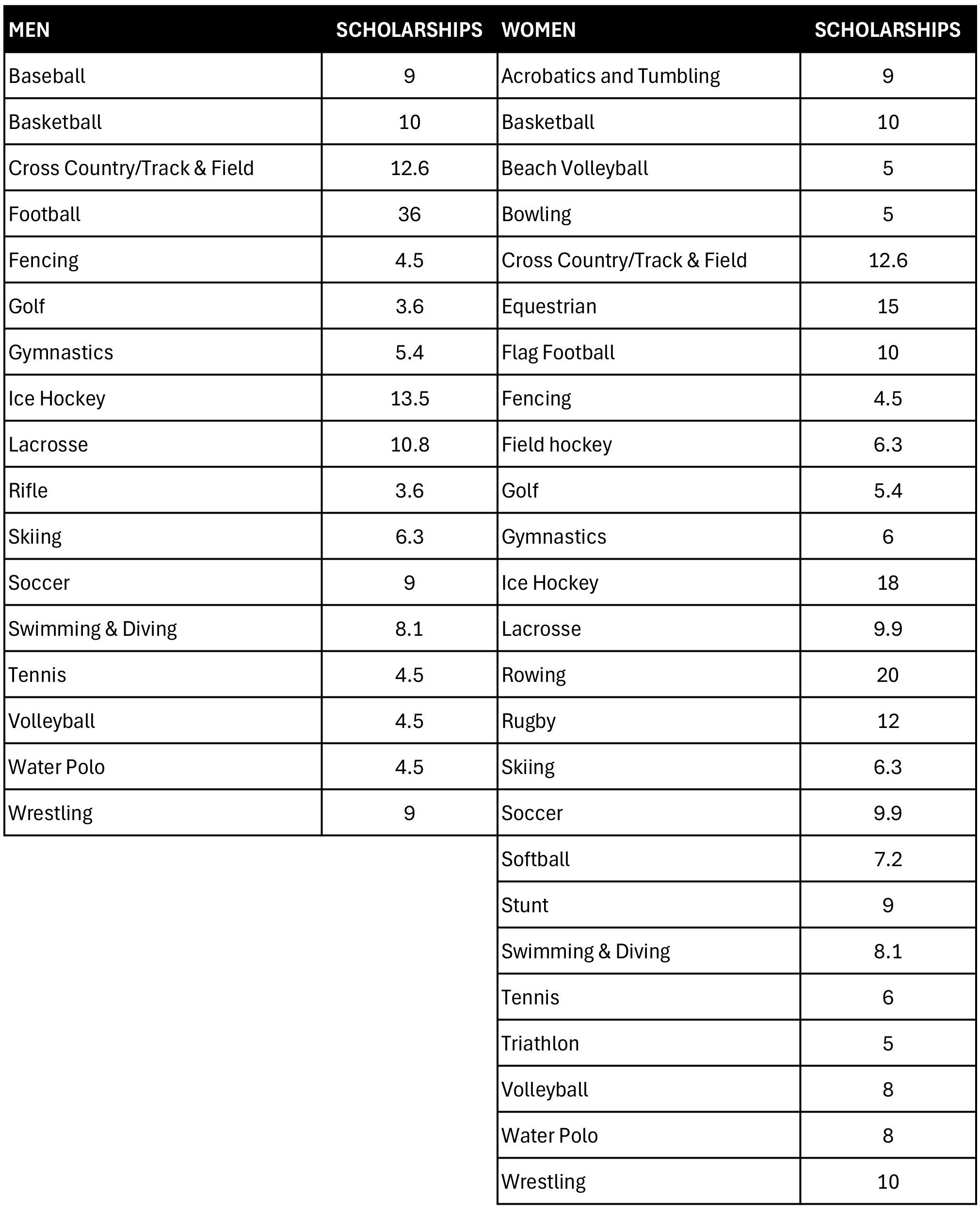
Division II uses a partial‑scholarship model for athletics aid. Very few D2 athletes receive a full scholarship covering all expenses; most receive some athletic aid to help with costs. Remaining expenses are typically covered by academic scholarships, merit scholarships, need-based grants, student loans and earnings from work. The partial‑scholarship approach is often called an “equivalency” system because Division II schools may award athletic aid that adds up to a specified number of full grants per sport.
NCAA DIVISION III SCHOLARSHIPS
At NCAA Division III schools, athletes cannot receive athletic scholarships based on sports performance or ability.
However, Division III athletes often receive other kinds of financial aid, including:
- Academic merit scholarships: Based on GPA, test scores, class rank, leadership, etc.
- Need-based financial aid: Determined through FAFSA/CSS Profile and family income
- Institutional grants: School-funded aid available to all students
- Leadership or talent scholarships: For music, service, research, arts, debate, community involvement, etc.
- Outside/private scholarships: From local organizations, employers, foundations or civic groups
- Federal and state aid: Pell Grants, work-study, state grants, loans, etc.
About 75% (or more) of Division III athletes receive some form of merit or need-based aid.
A key distinction:
- Coaches at DIII schools can recruit athletes heavily
- But they cannot award aid because of athletic ability
- Coaches may still help recruits navigate admissions and identify merit/need-based aid opportunities available to all students
So in practice, a strong student-athlete at a D3 school might still receive a very large financial package — it just has to be tied to academics, need or other non-athletic criteria rather than sports participation itself.