NAIA AND JUCO GUIDELINES
naia
What is it?
The National Association of Intercollegiate Athletics (NAIA) is the next largest governing body after the NCAA (241 schools as of April 2026; more than 83,000 student-athletes). These are 4-year schools. Most of the schools are small, private schools with 66 schools having an enrollment of 2,000 and only a handful having more than 5,000.
Scholarships
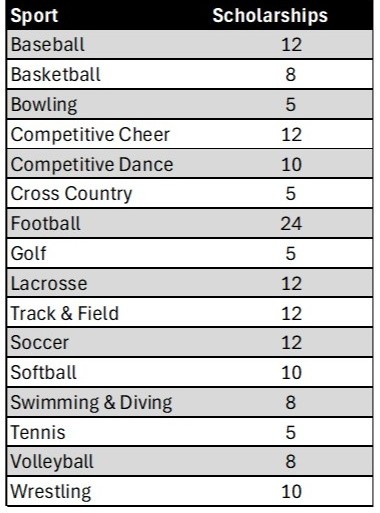
The NAIA uses an equivalency scholarship model, which means student-athletes typically receive partial athletic scholarships rather than full scholarships. These partial awards can be combined with academic scholarships, grants and other forms of financial aid to help cover college expenses. Each NAIA sport is allotted a set number of scholarship funds that coaches distribute across the roster. It’s also important to understand that athletic scholarships are not automatically renewed each year. Even if you receive aid as a freshman, future scholarship decisions are made annually by the coaching staff based on their evaluation criteria. Student-athletes can also combine athletic aid with academic scholarships and other forms of financial assistance.
The NAIA does not have an official National Signing Day for prospective student-athletes. Committing to an NAIA program is non-binding, meaning there is no formal agreement that locks a student-athlete into attending a specific school. Although some NAIA programs may ask recruits to sign a National Letter of Intent, those agreements are also non-binding.
All student-athletes must meet academic eligibility requirements to compete in NAIA programs. To receive an NAIA Eligibility Number, students must register through the official NAIA eligibility website. Athletes can begin the registration process any time after their junior year of high school.
To obtain an NAIA Eligibility Number, students must provide:
- Basic personal information
- Proof of high school graduation
- Either a 2.3 GPA or two of the following three academic benchmarks: A minimum score of 18 on the ACT or 970 on the SAT; At least a 2.0 GPA on a 4.0 scale; Graduation in the top 50% of their class.
The registration fee is the same for students from the United States and Canada. International students must pay a higher registration fee.
Expert Advice
Athletes that are open to smaller, private schools at the NCAA Division II and III levels should also be open to NAIA schools. The top NAIA schools are comparable athletically to NCAA Division II schools. There are essentially no contact rules for NAIA coaches with athletes. Coaches can contact athletes at any time with no limits on how (calls, texts, emails, etc.) they can make contact. NAIA programs prioritize maintaining a healthy balance between athletics and academics. This environment allows student-athletes to devote more time and focus to their education while still competing at a high level.
What are NAIA schools and why you should consider them
NJCAA
What is it?
The National Junior College Athletic Association (NJCAA) are 2-year colleges and are often called “JUCOs.” There are 525 schools in all divisions (D1, D2, D3). Athletes that attend JUCO schools can leave after 1 year for a 4-year school if they are academically eligible to do so. Every year an athlete plays at a JUCO, the athlete loses 1 year of eligibility to play at a 4-year school.
If you’re thinking about playing for an NJCAA program, you may be asked to sign a Letter of Intent (LOI) covering one academic year. Signing an LOI means you’re committing to that school’s program and other NJCAA schools cannot recruit you during that year. Before signing, take time to carefully review the agreement and fully understand the terms, as each LOI may differ.
Many states — for example, CA, TX, IL, WA, MI, NC, OR, and MA — have transfer agreements between community colleges and 4‑year universities to simplify student transfers. These agreements frequently guarantee admission to specific universities for community college students who meet set criteria. Requirements and programs vary by state, so student‑athletes should stay in contact with admissions offices at both their current college and their intended transfer university.
Scholarships
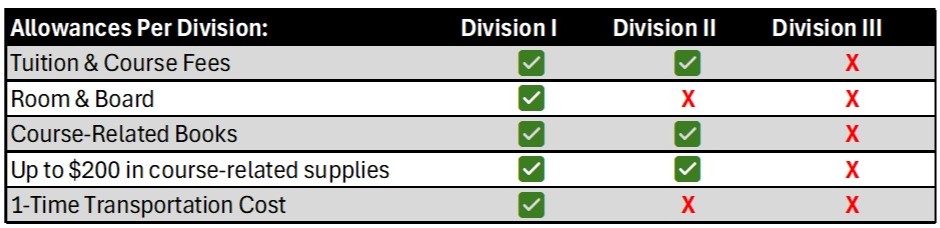
NJCAA schools can offer athletic scholarships at its Division I and II levels. Scholarships are not offered at its Division III level. Below is what is allowed by division. Junior colleges often provide academic scholarships. Typically, eligibility requires a minimum GPA around 2.5, though some schools instead ask for a qualifying SAT or ACT score. Check a specific junior college’s financial aid page for its exact requirements.
Expert Advice
The athletes that attend JUCOs usually do so for three main reasons: 1) Not academically eligible to play at a 4-year school or his or her poor academics are preventing him or her to get much four-year school recruiting attention; 2) Gives the athlete a second chance to get recruited by 4-year schools and improve their athletic abilities; 3) JUCOs are usually significantly less expensive than 4-year schools.
What are JUCOs and why many athletes should consider them
CCCAA
What is it?
All California JUCO schools are a member of the California Community College Athletic Association (CCCAA). Member schools typically only recruit California athletes. The association has 110 schools.
Scholarships
The CCCAA does not offer athletic scholarships. However, athletes oftentimes get other forms of scholarships, like academic, depending on the institution.
Expert Advice
Out-of-state recruits must contact the schools directly and unsolicited to first establish first contact and express interest. From there, schools can provide information regarding their program and institution.